
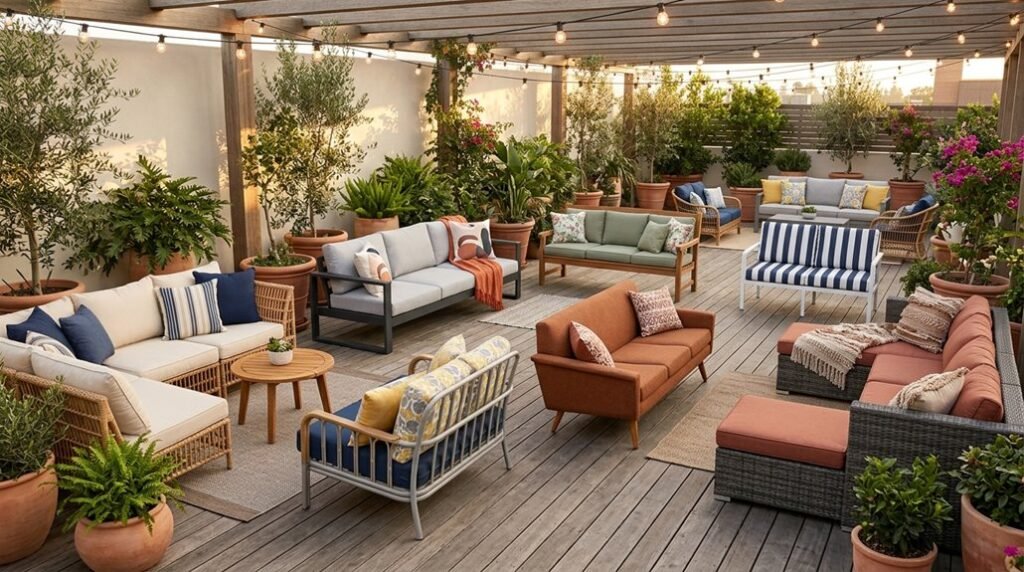
Your outdoor space deserves better than mismatched lawn chairs and regret. I’m here to walk you through how thoughtful sofa selection, from low-profile silhouettes that preserve sightlines to budget-friendly builds using concrete blocks, can completely reshape your patio’s functionality and aesthetic.
The right seating anchors everything: your gatherings, your plants, your whole backyard vibe. But here’s the thing: proportion matters more than you’d think, and I’ve got nine more strategies that’ll surprise you.
Scale Your Sofa to Your Space and Layout
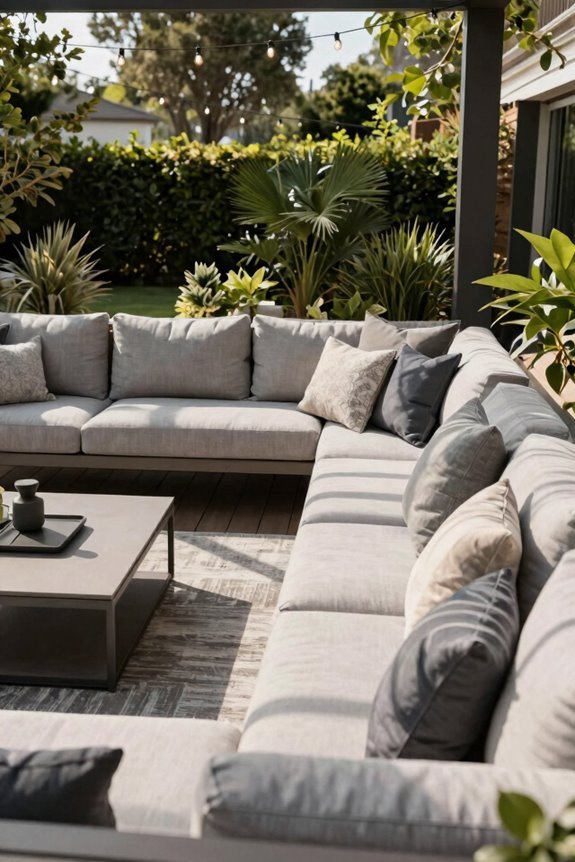
How do you know if that gorgeous sectional will actually work on your patio, or if it’ll dominate the space like an unwelcome houseguest?
I’ve learned that measuring your outdoor space first prevents costly mistakes. Start by noting dimensions, then map out where your sofa actually fits. Leaving breathing room for movement and circulation matters more than you’d think. Smaller patios? I’d skip the sectional dream and opt for a compact loveseat or sun lounger instead.
Larger areas unlock creative possibilities. I create multiple zones: a cozy seating cluster paired with a bistro set, so nothing looks dwarfed or lonely. The key is balancing your sofa’s scale against surrounding tables, planters, and pathways. When proportions align harmoniously, your outdoor space transforms into an inviting haven where you belong.
Choose Low-Profile Silhouettes for Open Sightlines
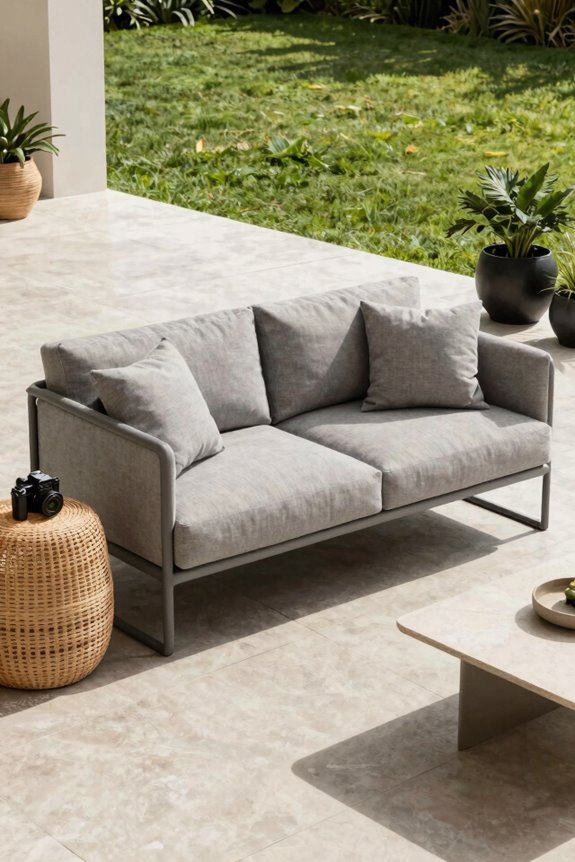
I’ve found that low-profile sofas, those sitting around 28–34 inches tall with compact back angles near 95–105 degrees, let you preserve views of your plants, focal features, and the actual sky (a luxury we often forget about). Pairing these streamlined pieces with slim armrests and bench-style bases positioned at the corners creates an uncluttered flow that makes even modest patios feel expansive.
Thin high-density cushions (1.75–2.5 inches) keep the visual weight minimal without sacrificing that sink-in comfort. When you couple your bespoke low-profile sofa with slender coffee tables and ottomans, you’re not just arranging furniture; you’re orchestrating sightlines that actually let people enjoy the space instead of just staring at upholstery.
Maximize Sightlines and Views
When you’re designing an outdoor living space, nothing kills the vibe quite like furniture that blocks your view of the scenery you paid good money to enjoy. I’ve learned that positioning your outdoor sofa strategically changes everything. Face those taut, low-profile frames toward your yard’s best features, whether that’s tall trees, a crackling fire pit, or your entertainment zone.
| Design Element | Impact | Why It Matters |
|---|---|---|
| Narrow armrests | Minimal obstruction | Preserves sightlines |
| Slim legs | Enhanced openness | Less visual weight |
| Modular configuration | Flexible arrangement | Adapts to your view |
The secret is to choose custom pieces with slender proportions rather than bulky single sofas. Pair them with minimal cushioning and unobtrusive side tables. You’ll create an airy gathering space where everyone actually sees what they’re looking at, which is practical design at its best.
Low-Profile Furniture Benefits
Low-profile sofas are your hidden advantage for keeping sightlines crystal clear without sacrificing comfort. These streamlined pieces, typically spanning 28 to 34 inches in height, preserve your view toward greenery, fire pits, and garden focal points that deserve center stage. I’ve found that choosing low-profile furniture with slim armrests and understated frames transforms cramped patios into spacious retreats.
The benefit emerges when you pair these slender silhouettes with raised coffee tables and delicate side tables. Neutral tones and minimalist designs blend seamlessly with any outdoor aesthetic, creating visual continuity that makes your space feel open. You’re not just buying a sofa; you’re curating an open, cohesive environment where sightlines flow unobstructed. That’s the thoughtful approach to patio design that homeowners genuinely want.
Space Perception and Flow
Your patio’s perceived size hinges on what you can actually see beyond your seating arrangement, and that’s where low-profile designs work well. When you choose sofas with tapered legs and slim armrests, you’re creating visual breathing room. The eye travels freely across your space instead of hitting a wall of upholstery.
Pairing these streamlined pieces with vertical accents like towering bamboo or cascading plants deepens your sense of space without blocking sightlines. Lower furniture doesn’t mean smaller; it means smarter. In compact patios, shallow-depth sectionals become custom solutions for maximizing floor flow.
Position your sofa facing a focal point, whether that’s your garden view or fire pit, and suddenly your modest patio feels intentionally designed, generously proportioned, and welcoming.
Build a Budget-Friendly Sofa From Lumber
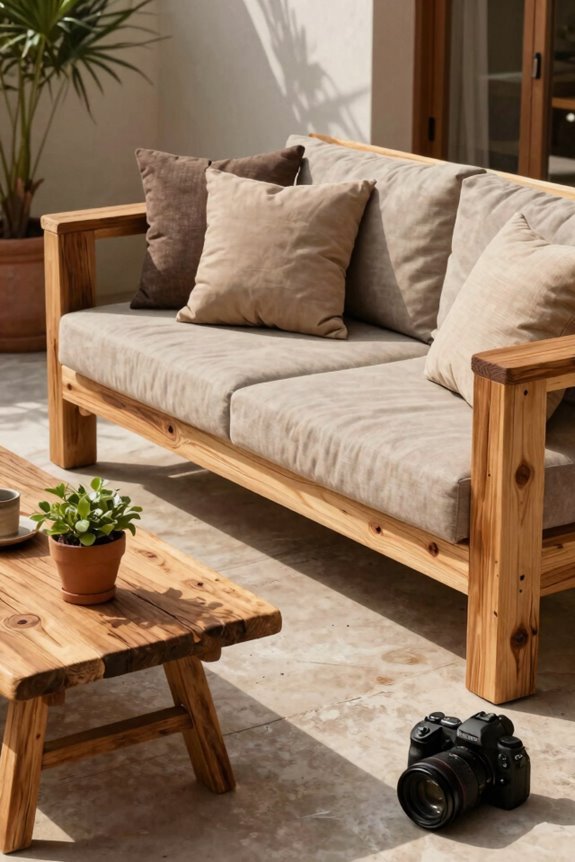
Building outdoor sofas from lumber is surprisingly accessible—you’re looking at roughly $50 in materials per sofa, which means you can construct three sturdy seating pieces for under $800 total. I’ve transformed my patio using DIY outdoor furniture that’s both functional and inviting.
Here’s what makes this approach work:
- Frame construction using Ana White plans as your blueprint
- Pressure-treated lumber that resists weather and rot
- Strategic cushion placement (yes, they’re pricey, but worth it)
- Modular design allowing flexible arrangements
The real magic happens when you realize cushions drive costs, not the frames themselves. Your bespoke seating setup doesn’t require a designer budget; just patience and basic tools.
You’re joining a community of makers who’ve ditched cookie-cutter furniture for genuine outdoor comfort that reflects your style.
Create a DIY Sectional With Twin Mattresses
I’ll show you how to craft a comfortable outdoor sectional using twin mattresses. This strategy slashes costs while delivering customizable comfort. You can arrange these cushioned cores into L-shapes, U-shapes, or sprawling configurations that suit your patio’s dimensions and footprint, then dress them up with weather-resistant frames built from cedar or composite lumber so your sectional stays stable in the wind.
The practical appeal here? Twin mattresses cost a fraction of traditional sectional pieces, and swapping out worn cushions means you’re not replacing an entire $3,000 sofa. You’re simply refreshing the core.
Budget-Friendly Sectional Assembly
When you’ve got twin mattresses languishing in a guest room and a patio that needs seating, you’re basically halfway to a custom sectional that’ll cost a fraction of store-bought alternatives.
I’ve discovered that building modular outdoor furniture this way transforms your space without decimating your budget. Here’s what makes it work:
- Source pressure-treated lumber for frames; it’ll resist rot and weather beautifully
- Layer twin mattresses atop your wooden base for plush, comfortable cushioning
- Wrap everything in UV-resistant exterior fabric to shield against sun damage
- Mix and match sections to create an L-shaped or sprawling configuration
Your sectional adapts as your needs shift. Stack sections differently. Add pieces gradually. You’re crafting furniture that grows with your life, not your credit card debt.
Twin Mattress Cushioning Options
Twin mattresses aren’t just for guest rooms anymore. They’re your concealed advantage for creating a sectional that’s truly comfortable without the expensive price tag. I’ve discovered that pairing these plush foundations with a sturdy frame transforms your patio into a modular marvel. You stack them strategically, and suddenly you’ve got deep, inviting cushioning that rivals high-end outdoor sectionals.
The beauty is flexibility. Need to accommodate more guests? Add another mattress module. Reconfiguring your layout takes minutes, not movers.
I recommend wrapping your twin mattresses in weather-resistant outdoor fabric—think durable Sunbrella or similar performance textiles. Then add removable, washable covers for easy maintenance.
This approach delivers that cloud-like comfort while your wooden or metal frame provides structure and back support. You’re not compromising; you’re innovating smartly.
Customizable Layout and Sizing
Once you’ve wrapped your mattress foundation in weather-resistant fabric, you’re ready to explore the real benefits: arranging them however your space and your entertaining needs demand. Your outdoor sectional isn’t locked into one configuration. Instead, you’re designing a custom seating experience that adapts.
Consider these layout possibilities:
- L-shaped arrangement for corner spaces that maximize your patio
- Floating pods positioned around a fire pit for intimate gatherings
- Linear formation along a deck for sunbathing and socializing
- Modular clusters that shift based on seasonal entertaining needs
You control the depth, height, and width. Twin mattresses let you customize seat firmness too; stack them for lounging or keep single layers for upright conversation. This flexibility means your outdoor living space evolves with you, not against you.
Repurpose Concrete Blocks Into Built-In Seating
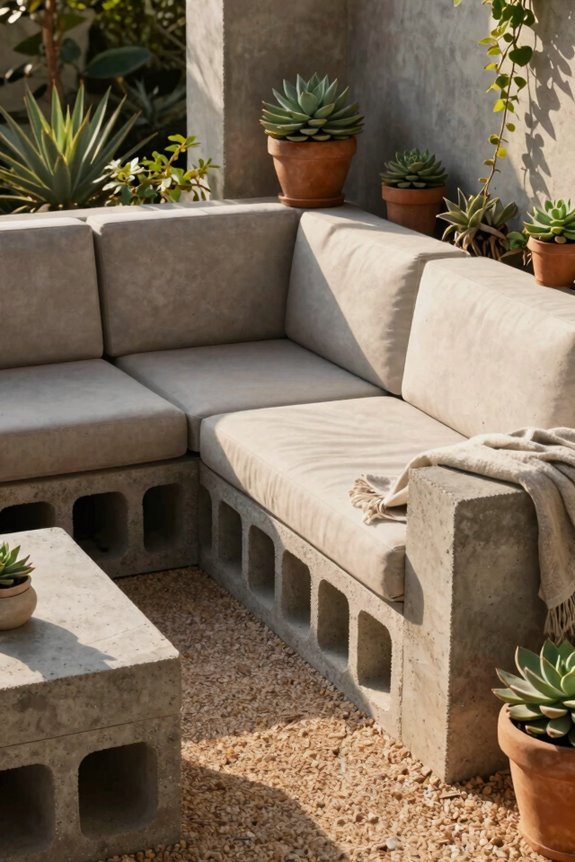
How’d you like to build sturdy outdoor seating without emptying your wallet? I’ll show you how concrete blocks transform into custom patio furniture that’ll enhance your outdoor space. Stack these humble cinder blocks to varying heights, and you’ve got a modular base that adapts to whatever patio layout you’re working with, no fancy carpenter required.
Top them with timber sleepers or stone, add some cushions, and suddenly you’re relaxing in comfort. The beauty? You can integrate planters behind your seating, creating green backdrops that blend functionality with garden aesthetics. Grout or mortar locks everything stable.
This budget-friendly approach proves you don’t need expensive patio ideas to create comfortable seating arrangements. Your space deserves this upgrade.
Style Your Sofa With Layered Cushions and Throws
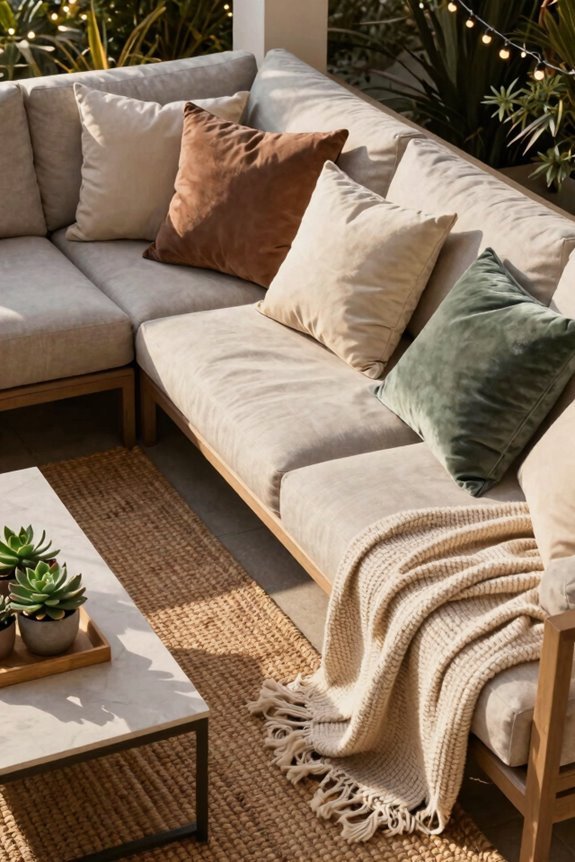
I’ll improve your patio sofa by layering cushions strategically. Think two hefty 55×55 cm back cushions anchoring the scene, then smaller 43×43 cm pillows in front to add pattern without creating a fabric traffic jam. You’ll want to mix textures like weather-resistant outdoor textiles with cozy fleece throws, which you can rotate seasonally to keep things fresh.
Let those throws echo your room’s color story through intentional accent choices. The trick here is balancing large and small cushions at each end so your sofa looks curated, not claustrophobic. Plus, machine-washable, quick-dry covers mean you’re not one rainstorm away from a maintenance problem.
Cushion Sizing and Placement
Why settle for a flat, uninviting sofa when you can transform it into a layered retreat of comfort and style?
I’ve discovered that strategic cushion placement creates both visual depth and genuine coziness. Here’s my formula for success:
- Start with 55 x 55 cm back cushions as your foundation, anchoring the look with substantial support
- Layer 43 x 43 cm cushions in front to add pattern and invite you deeper into the seat
- Position largest cushions at the ends, graduating toward smaller pillows at center for balanced composition
- Choose outdoor fabrics with quick-dry or fade-resistant properties to protect your investment
I alternate solids with patterned accents, creating focal points without clutter. This graduated sizing approach isn’t just visually smart; it’s ergonomically brilliant.
You’ll find yourself sinking into real comfort while your patio looks intentionally curated, not haphazardly decorated.
Texture and Material Selection
What transforms a sofa from merely functional to truly inviting? The right textures and materials. I’ve discovered that mixing durable Sunbrella fabrics with plush fleece throws creates the perfect balance: weatherproof yet wonderfully cozy.
Layer smooth outdoor leather-look pieces alongside woven upholstery to build visual depth that makes your space feel curated, not generic.
| Material | Benefits | Feel |
|---|---|---|
| Sunbrella | Fade-resistant, mildew-proof | Crisp, reliable |
| Fleece throws | Warmth, softness | Luxuriously plush |
| Woven upholstery | Texture, durability | Naturally inviting |
A cohesive color palette unifies everything beautifully. I recommend choosing 2-3 complementary hues across cushions and throws. This customized approach maximizes versatility for seasonal updates.
Weather-ready accessories like faux fur covers adapt to temperature swings, letting you personalize your outdoor space year-round without constant replacement.
Color Coordination Strategies
- Pair neutral Sunbrella base cushions with vibrant accent pillows, think Bahamian pink, for visual interest without overwhelming the space.
- Vary cushion sizes (55×55 cm backs, 43×43 cm companions) to create depth and architectural interest.
- Alternate smooth bases with textured throws to amplify color perception through tactile contrast.
- Coordinate surrounding elements: potted plants, outdoor rugs, and lighting within your chosen palette for cohesion.
This bespoke layering strategy looks intentional and feels luxurious. Your guests won’t just see comfort; they’ll feel the curated thoughtfulness behind every placement, making your outdoor space truly worthwhile.
Arrange Modular Seating for Flexible Gatherings
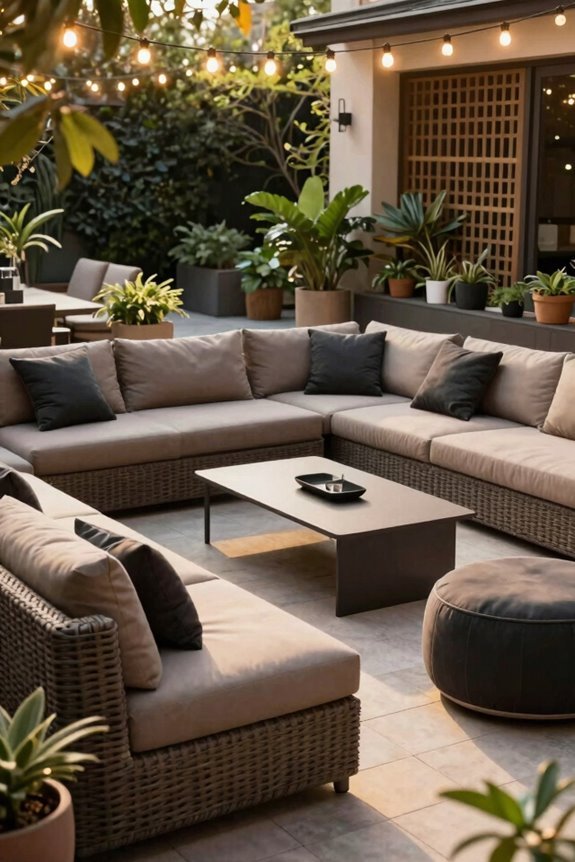
When you’re tired of furniture that commits you to one look, modular seating is your answer—it’s the chameleon of outdoor living. I’ve found that mixing armless loveseats, corner pieces, and ottomans transforms my patio from intimate gathering spot to full-blown dinner party headquarters without breaking a sweat (or my back).
The flexibility comes when you choose lightweight, weather-resistant materials—think solution-dyed fabric and powder-coated aluminum—that let you rearrange on a whim. I strategically position sections to create clear pathways while anchoring sightlines toward focal points: my fire pit, lush backdrop of hanging planters, and water feature.
Nesting tables and storage ottomans become your best-kept tool, adapting rhythm without cramping the space. That’s how you build a gathering place that actually evolves with your social calendar.
Orient Seating to Maximize Views and Flow
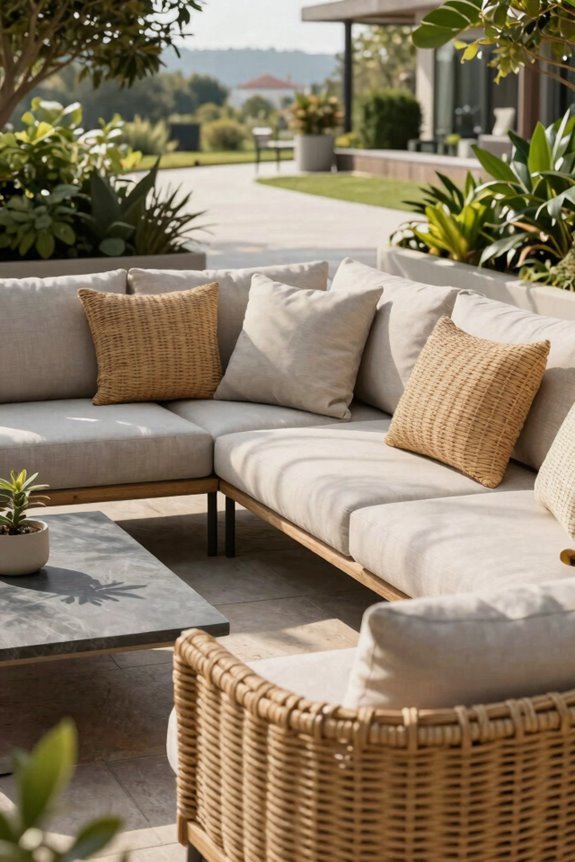
Now that you’ve freed the freedom of modular pieces, the real magic happens when you point them toward something worth looking at. Your patio deserves sightlines that sing, whether that’s verdant landscape views or your entertainment zone.
Here’s how to nail orientation:
- Position your primary sofa facing the focal point, ensuring unobstructed views that anchor the space
- Mix seating angles strategically with chairs angled toward the same vista, creating cohesive conversation zones
- Maintain low-profile furniture placement to preserve openness and prevent visual crowding (nobody wants a sectional fortress)
- Leave generous pathways around seating that invite natural circulation without awkward furniture shuffles
Balance is everything. A bespoke arrangement respects both the view and how guests move through your outdoor space. You’re creating belonging through thoughtful placement.
Layer Lighting Around Your Patio Sofa Setup
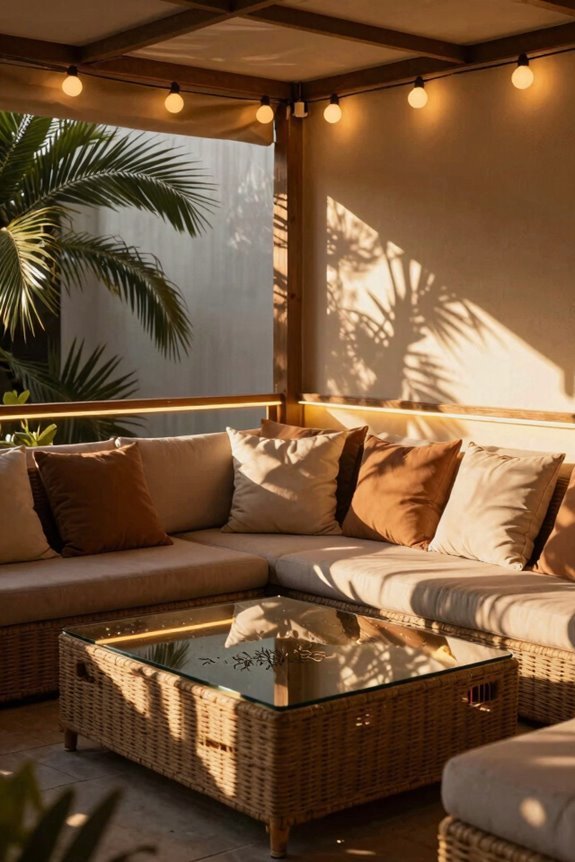
What transforms a patio sofa from daytime lounging spot into an evening gathering space? Layered lighting. I’ve discovered that combining ambient, task, and accent fixtures creates depth while preventing that awkward spotlight effect (nobody wants to feel interrogated by their own patio).
String lights overhead, wall-mounted sconces, and ground-level uplights work together beautifully. Varying heights matter tremendously: pendants, tall stakes, and low-level floor lamps sculpt shadows and highlight your furniture’s silhouette. Position task lighting near the coffee table for functionality, tucking accent sources behind seating to dodge direct glare.
Choose dimmable fixtures with warm color temperatures (2700–3000K) for that coveted cozy atmosphere. This bespoke approach transforms your outdoor space into an inviting retreat where you’ll actually want to gather.
Anchor Your Sofa Zone With Functional Accessories
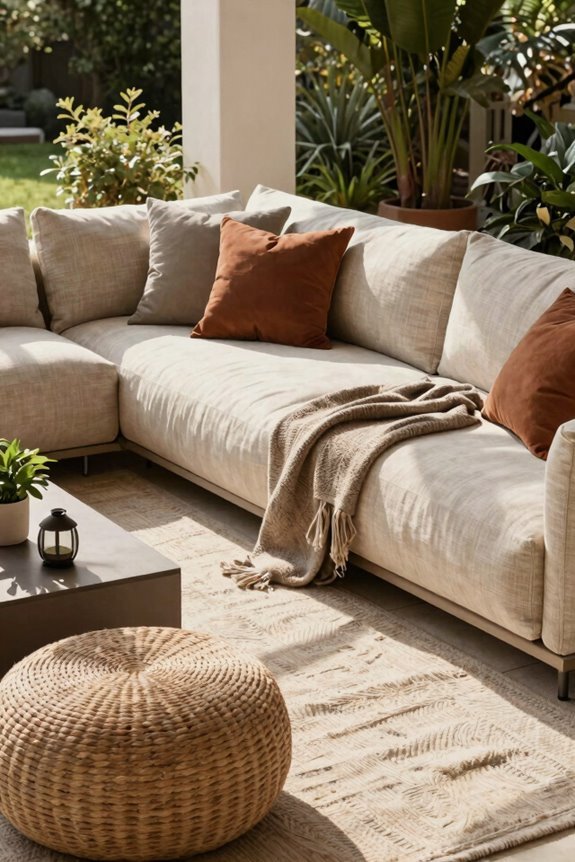
How do you prevent your patio sofa from floating like a lonely island in an endless sea of deck? You anchor it with intentional, functional pieces that transform scattered seating into a gathering hub.
Anchor your patio sofa with intentional, functional pieces that transform scattered seating into a true gathering hub.
I’ve found that strategic accessories create both structure and belonging:
- Sturdy coffee tables or side tables positioned within arm’s reach; your drinks deserve a home
- Storage benches or ottomans that hide blankets while offering extra seating (dual-purpose functionality)
- Planters with green foliage softening zone boundaries while adding vertical interest
- Coordinated throws and cushions in cohesive palettes that ground the space visually
These elements work together like a well-orchestrated ensemble. A weathered wooden ottoman paired with linen cushions doesn’t just look inviting; it signals to guests that this is where you belong. Your sofa zone becomes less furniture arrangement and more sanctuary.